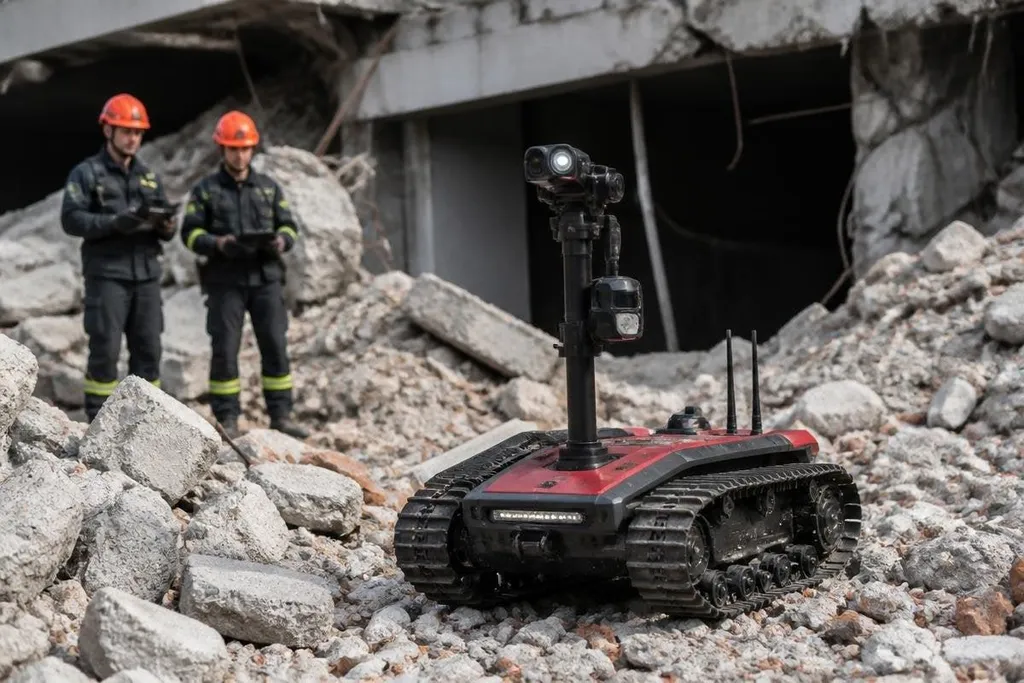
A rescue robot may need to move through rubble, smoke, floodwater, or a damaged industrial site while people stay outside the danger zone. The hard part is proving that it can keep working when its sensors lose sight of the route and its operator loses a clean view.
- The job: find people, inspect hazards, or carry tools into unsafe areas
- The test: movement, sensing, communication, and recovery after failure
- The gap: a controlled demo does not prove field performance
What rescue robots must do
Rescue work varies by site, so a useful robot needs more than a strong motor. A ground robot may need tracks or legs for broken floors, a camera mast for a higher view, and a radio link that keeps working through concrete and metal.
That link matters because many rescue robots are remotely operated. The person controlling the robot may be hundreds of metres away, watching video with a delay. A short loss of signal can stop the robot at the worst point in a search.
The robot also needs to carry the right tools. A camera can help locate a person, while a thermal sensor may show heat through smoke.
A small arm can move light debris or open a door, but it may lack the force needed for a collapsed structure. Payload, battery time, weight, and size all affect where the robot can go.
Why the race is difficult
Rescue sites are hard for sensors. Dust can block cameras. Water can damage electronics. Smoke can reduce visibility. LiDAR, which measures distance with laser pulses, can lose useful readings when surfaces are covered or the air is full of particles.
The robot must also understand its position. Simultaneous localization and mapping, or SLAM, lets a system build a map while estimating where it is inside that map. A damaged building can confuse SLAM when walls have moved, floors are uneven, or familiar shapes no longer match the stored view.
Movement brings another problem. A tracked robot may cross loose material well but struggle on stairs. A legged robot can step over gaps, yet each foot placement needs careful control. A flying robot can reach a higher view, but its battery time and flight space may be limited indoors.
These limits make rescue robotics a systems problem. A good camera cannot fix a weak radio link. Extra batteries add weight. More sensors add power use and more data for the operator to read.
What counts as proof
A rescue robot earns its place when smoke blocks a camera or rubble traps a wheel. Robot24 can place those failures beside the named machine and test site, so you can judge the work shown rather than the promise around it. The next check is the record of what happened.
That distinction starts with the test record. A useful report should name the site, the task, the control method, and the conditions. It should say how long the robot ran, how often the link failed, and what happened when the machine got stuck.
A video can show movement, but it may leave out setup time, operator input, or failed attempts. A rescue team also needs to know how many people must travel with the robot, how long repairs take, and whether the machine can be carried through a narrow entrance.
The open question is repeatability. A robot that completes one careful run has shown a result. A robot that completes the same task across several sites, operators, and weather conditions has given teams more reason to plan around it.
A buying guide for rescue teams
Before a fire service, search team, or industrial safety group chooses a robot, check these points:
- Name the task: decide if the robot will search, map, inspect, carry, or communicate.
- Check the route: measure stairs, door widths, loose ground, water depth, and expected radio range.
- Read the test record: ask for run time, failures, recovery steps, and operator workload.
- Count the crew: include the people who transport, control, repair, and monitor the robot.
- Price the full kit: include batteries, chargers, spare parts, training, software, and transport cases.
I'd skip any rescue robot sold on a smooth demonstration without a clear failure record. Rescue teams buy time and information, so a machine that stops without warning can create another problem at the scene.
What happens next
The field will move forward when makers publish repeatable tests from real sites, with clear limits beside the successful runs. Until then, the useful question is simple: can this robot complete the assigned task, under the expected conditions, with the crew and spare parts available on the day?